


.png)
.png)
- On sale!


Did you find it cheaper? Get in touch with us...We will do our best to benefit you!

 Política de segurançaWe use reputable external institutions such as SIBS, Eupago, and Cofidis for payments.
 Política de expediçãoSee our shipping policy
 Política de devoluçãoReturn policy
The Compact Disc format has been with us long enough to have a huge catalog of music of all types at a very affordable price. Even the most ardent acolytes of streaming music will concede that there's still plenty of life left in the little silver discs. CXC allows you to extract every last drop of musical enjoyment from your CD collection.
Expert in one thing, without dedicating itself to anything else, the CXC accurately reads the data stored on the CD, solely and exclusively.
S3 SERVO TECHNOLOGY
At the heart of the CXC is Cambridge Audio's legendary S3 servo design.
Designed for efficient reading of CD digital data with cutting-edge error correction, it is designed to play audio CDs brilliantly. CDs with audio data need to spin at about 210 rpm when the laser is on the outside and up to 480 rpm when it is in the center. That's where the S3 servo nails it, moving the CD at the exact speed required to read the audio data. The contrast with the 1530 rpm required to read DVD information makes it evident why a reader of various disk formats is not capable of achieving the precision of CXC, created solely and exclusively for reading CDs.
WHAT IF YOU WANT TO PLAY OTHER FORMATS ON COMPACT DISC?
It is not possible to play SACD, MP3 or WMA discs on the CXC, as it is designed for optimal reading of CDs.
For playing MP3/WMA discs, the AXC25/35 or the CXUHD are the most suitable Cambridge Audio models. For universal playback of all types of compact discs, the British firm recommends the CXUHD.
What is the difference between CD transport and CD player? The player reads and decodes the data, while the transport is dedicated exclusively to extracting all the data from the CD and sending it raw to another device that decodes it. And for this, you need a digital output.
MINIMAL ANALOG DEGRADATION
By working with the signal in its digital form as much as possible, and performing decoding at the latest possible point, there is less chance of the signal suffering from analog degradation compared to a traditional CD player with analog outputs.
WHAT IS THE BEST WAY TO CONNECT A CXC, CXN streamer and a CXA amplifier?
For optimal sound quality, Cambridge Audio recommends taking advantage of the dual Wolfson DACs built into the CXN. The CXC needs to connect to the CXN via S/PDIF and then the CXN will connect to the CXA via XLR or RCA cables depending on the model. Once done, it will only be necessary to select the digital input on the CXN.
For a faster and more convenient connection, you can connect the CXC directly to the CXA using a TOSLINK optical cable.
And if you want the best of both worlds, you can combine them for different listening moments. The S/PDIF and optical TOSLINK outputs work simultaneously on the CXC, so you can choose the direct connection to the CXA for those times when you don't want to complicate things at all, and choose the S/PDIF connection to the CXN for those times when you are looking for optimal playback and quality.
HIGH QUALITY DIGITAL OUTPUTS
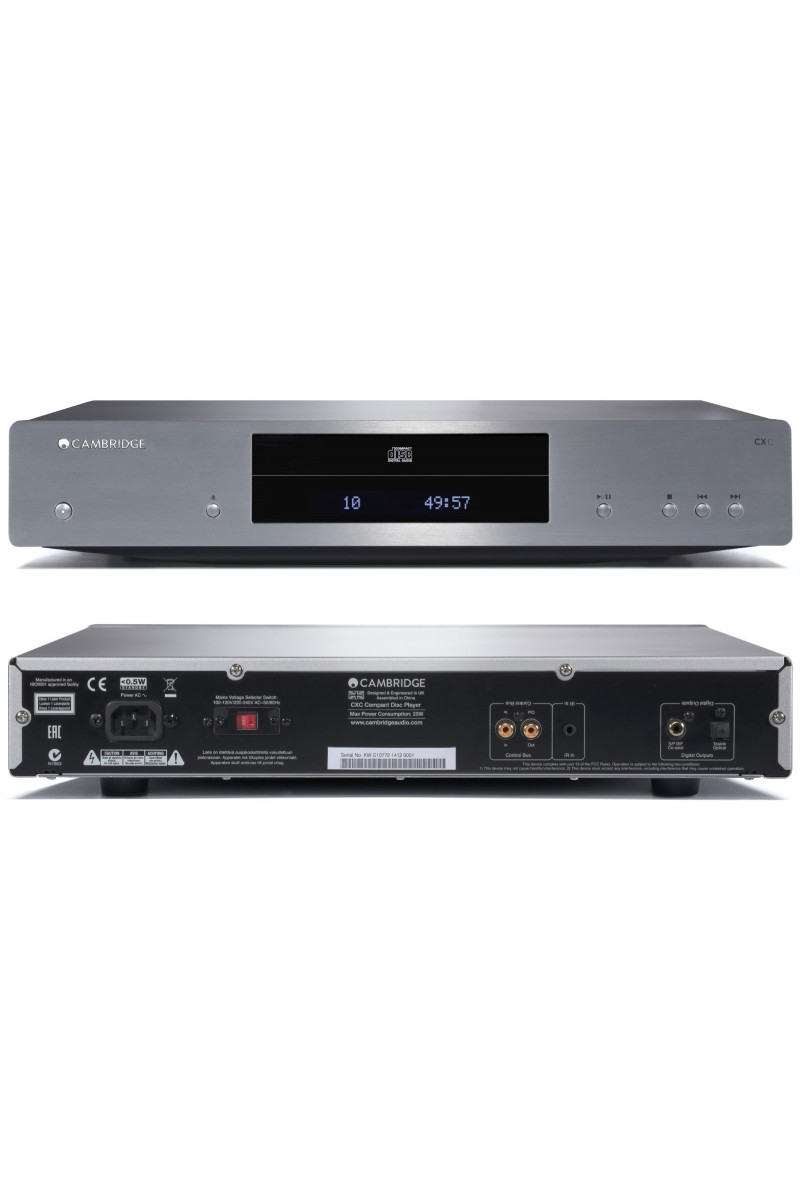
The CXC has both an optical TOSLINK digital connection and an S-PDIF coaxial connection.
The design not only looks smart. It also has practical advantages regarding sound quality.
METAL CHASSIS WITH ACOUSTIC INSULATION
Electronics, and specifically their sound quality, are particularly susceptible to vibration, which is why Cambridge Audio has used a low-resonance, sound-isolating metal chassis to eliminate as much vibration as possible to ensure you extract the best sound quality from your CD collection.
FLOATING DESIGN
All CX Series devices have a clean, tailored design, with chamfered chassis for a fascinating look that makes them appear to float when placed together, one on top of the other.
Specific References
No customer reviews for the moment.